Mainland Litter editorial · Published · Buyer education · 7 min read
Before printing private-label cat litter bags, approve three connected records: the product identity, the artwork revision and the evidence required for the printed barcode. A beautiful pouch design is only ready for production when its contents, code and receiving-channel requirements agree. Keep those decisions together so a last-minute pack change does not silently create an incorrect retail item.
This guide is for importers, distributors and pet brands preparing their first printed bag or revising an existing range. It covers artwork and barcode approval, rather than packaging barrier performance or container capacity. The checklist is a suggested purchasing tool; your brand team, printer and trading partners should confirm the requirements for the actual product and market.
- 01 / DEFINEIdentify the retail item.
Formula, variant, pack size and approved code.
- 02 / REVIEWApprove the artwork.
Dieline, copy, barcode space and revision.
- 03 / RELEASECheck the printed pack.
Agreed verification evidence and written sign-off.
Start with a product identity sheet, not a bag mockup
Create one row for each item you intend to sell. Record the brand, litter formulation, scent or other variant, declared pack quantity, language version and intended sales channel. Add your internal SKU and the person responsible for approving the product identifier. A designer should receive these decisions as controlled input rather than infer them from an old photograph.
Keep the quantity and its unit explicit. A weight declaration and a volume declaration are different fields; do not let a layout change turn one into the other. When reviewing a tofu cat litter reference profile, separate the sourcing ranges from the exact declaration proposed for your finished retail bag. Agree that declaration before the printer builds the final file.
For a range with several variants, put the approved text and code beside each variant in the same sheet. Ask a reviewer to compare the front panel, back panel and master record together. This makes it easier to spot a correct-looking pouch carrying the code or quantity from a neighboring SKU.
Review GTIN changes before reusing an existing code
A Global Trade Item Number, or GTIN, identifies a trade item. GS1’s GTIN Management Standard, release 1.1, section 2.3 requires a new GTIN when legally required declared net content printed on the pack increases or decreases. Treat a revised quantity as an identification review, not simply a text correction.
For example, if a proposed repeat order changes a declared 6 L bag to 7 L, pause code reuse and have the responsible brand contact review the applicable rule. This is a hypothetical purchasing example, not a Mainland pack specification. Record the decision and update the artwork, product data and order documents together.
Maintain separate records for the retail unit and any outer case that is ordered as a trade item. Ask the buyer’s receiving team which identifiers and formats they need at each level. Do not ask a printer to decide the full identification hierarchy from a carton sketch.
Give the printer a controlled artwork brief
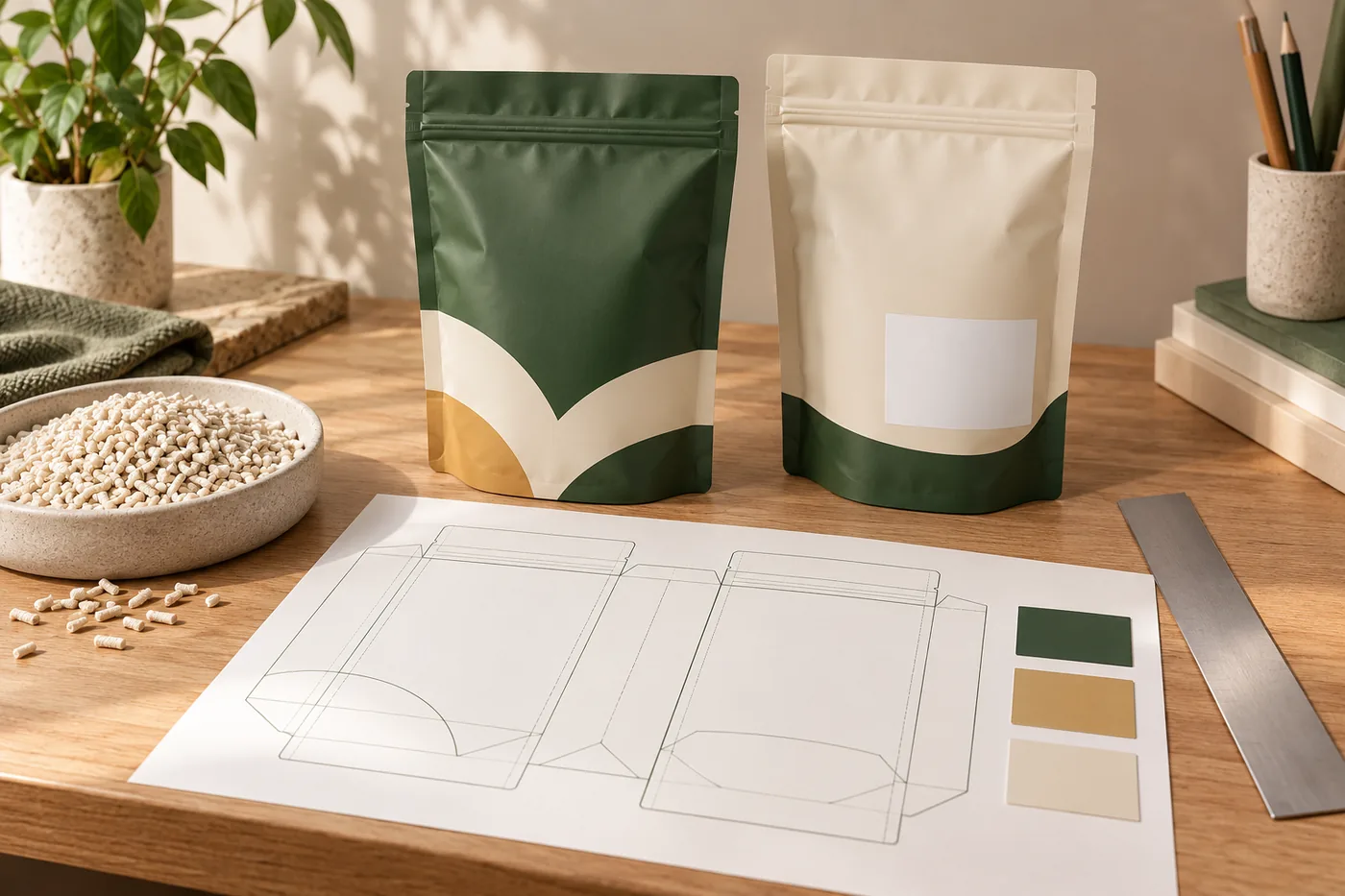
Supply a dimensioned dieline for the agreed bag construction. Identify the front, back, gussets, sealing areas, zipper and any handle or window. Ask the printer to confirm which areas can carry critical information after the bag is filled. A flat PDF can hide the consequences of a fold or a changed seal width.
Request a barcode panel sized and positioned for the selected symbol and printing process. Ask the reviewer to check its dimensions and surrounding clear space against the applicable specification; avoid applying a single generic dimension to every barcode. Record the background, ink and finish proposed for that panel so later decorative changes trigger another review.
Use a versioned filename and approval record, such as SKU, artwork revision and date. Keep one production master with a named owner. If a translation, quantity or barcode changes after review, issue a new revision and obtain fresh approval for the affected elements. “Use the latest attachment” leaves too much room for two suppliers to print different files.
Use an artwork approval checklist with clear owners
| Review field | Evidence to retain |
|---|---|
| Item identity | Brand, formula revision, variant, SKU, declared quantity and destination channel. |
| Code assignment | Approved GTIN record, responsible contact and decision on any product change. |
| Artwork copy | Approved language text, instructions and the owner of each product claim. |
| Bag construction | Dimensioned dieline, panel orientation, closure and printer-confirmed usable areas. |
| Barcode review | Symbol, dimensions, location, clear-space review and report requirements. |
| Printed sample | Identified sample, material and print revision, plus agreed verification evidence. |
| Production release | Exact master-file revision, written approvals, date and authorized production scope. |
Assign each review to someone who can make the decision. The importer can coordinate the record while the brand owner approves identity and copy, the printer confirms production feasibility, and the receiving partner confirms its acceptance requirements. Decide what must be resolved before printing starts and what evidence must be available before shipment.
Separate artwork review from printed barcode verification
GS1 New Zealand’s artwork guidance describes interim reports as provisional: artwork review cannot assess print quality and needs follow-up full verification. It asks for the final barcode dimensions and the material on which it will be printed. Use those distinctions when commissioning the review.
Ask exactly what the proposed service assesses, which sample it needs and which report it will issue. Keep the report tied to the file revision, substrate and print sample submitted. A report on a previous bag should not silently become approval for a different material or layout. A quick phone scan can be an informal check, but should not be represented as the agreed verification report.
GS1 Australia’s barcode testing checklist distinguishes artwork samples from final formed retail packs and explains that incomplete packaging can limit location assessment. It also has separate submission arrangements for heavy or bulky items. Confirm the service’s sample instructions before dispatching a large litter bag; do not assume every provider accepts the same sample format.
Agree how an unacceptable result will be handled before the main print run. Identify who receives the report, authorizes corrections and confirms the revised sample. Keep that review separate from the product-performance work in your cat litter sample testing plan.
Release one complete packaging revision to production
At sign-off, collect the approved product sheet, artwork master, print sample reference and required reports into one release record. State the purchase order and variants it covers. Confirm that the manufacturer and packaging printer have acknowledged the same revision, including any separately supplied carton artwork.
Keep product claims under their own approval. A passed barcode check does not support an absorption, disposal or environmental statement. Ask the responsible brand or market reviewer to approve the proposed wording and supporting evidence. Likewise, an attractive packaging proof does not establish transport protection; review the shipping moisture-control checklist separately.
For the next order, compare changes against the retained master before authorizing reuse. Through Mainland’s private-label project brief, share your formulation, pack format and approval responsibilities. To start a discussion, send your target market and packaging requirements; confirm printed-pack MOQ, timing and evidence in the quotation rather than assuming them from a design image.
Frequently asked questions
Can I reuse a cat litter barcode after changing the bag quantity?
Review the change before reuse. GS1’s declared-net-content rule requires a new GTIN for an increase or decrease in the legally required quantity printed on the pack. Have the responsible brand contact document the decision and update the connected item records.
Is a barcode checked on a PDF ready for production?
A PDF review can support artwork approval, but it does not assess the actual print quality. Agree the follow-up sample and report needed for the intended bag, printing process and receiving channel before releasing production.
Should I send a full heavy bag for barcode testing?
Ask the selected service first. Submission instructions can differ for retail packs, flat packaging and heavy items. Confirm which parts of the assessment are possible with the sample format you provide and retain that scope with the report.
Who should approve private-label cat litter artwork?
Assign named owners for product identity, copy, print feasibility and receiving-channel requirements. Release the exact file revision only after the agreed approvals are recorded. The printer’s approval of a file should not substitute for the buyer’s approval of its product information.
Sources and editorial scope
Reviewed November 2, 2026: GS1 GTIN Management Standard release 1.1, September 2023, section 2.3; GS1 New Zealand’s artwork guidance, version 3.2 updated March 28, 2024; and GS1 Australia’s barcode testing checklist, linked above. The table, workflow and procurement examples are editorial recommendations. They do not certify a Mainland package, guarantee retailer acceptance or establish destination-specific labeling compliance.
This guide is a purchasing framework. Confirm product-specific performance, documentation and commercial terms in your quotation.